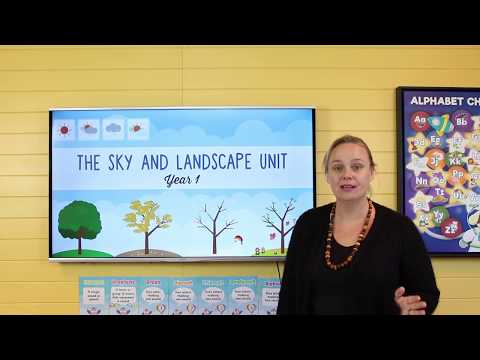
This unit has been designed for Year 1 based on the Australian Curriculum Earth and Space Sciences strand. Students will investigate the observable changes which occur in the sky and landscape.
When examining changes that occur in the sky, students will look at the moon, features of the sky during the day and night, observing and recording the weather and they'll consider the necessary precautions to take in case of extreme weather conditions.
They'll learn about the natural, managed and constructed features of the landscape.
Students will:
 Lesson 1
Observing Skies
Lesson 1
Observing Skies
In this lesson students will explore the sky and how it changes throughout the day and night.
 Lesson 2
Weather Changes
Lesson 2
Weather Changes
This lesson will discuss the seaons of the year and the changes that occur in each season.
 Lesson 3
Why is it cooler at night?
Lesson 3
Why is it cooler at night?
In this lesson students will investigate the reason why it is coller at night than during the day.
 Lesson 4
Changes to the Moon
Lesson 4
Changes to the Moon
In this lesson students will observe the changes that are happening to the moon this month.
 Lesson 5
Measuring Temperature
Lesson 5
Measuring Temperature
In this lesson students will look at other ways to observe changes in the weather during the day or night.
 Lesson 6
Safety in Weather
Lesson 6
Safety in Weather
In this lesson students will learn how to create an emergency kit and which rules to follow in case of a weather emergency.
 Lesson 7
Natural Features of the Landscape
Lesson 7
Natural Features of the Landscape
In this lesson students will learn about natural features we see in the environment.
 Lesson 8
Constructed Features of the Landscape
Lesson 8
Constructed Features of the Landscape
In this lesson students will learn about the constructed features within their envirnoment.
 Lesson 9
Managed Features of the Landscape
Lesson 9
Managed Features of the Landscape
In this lesson students will look at manafed features within the environment.
 Lesson 10
Changes in the sky and landscape
Lesson 10
Changes in the sky and landscape
In this lesson students will be assessed on what they have learn in this unit, the sky and landscape.
The WALT, WILF & TIB posters were created by request and consist of 14 pages including: WALT - We are learning to... WILF - What I'm...
This presentation includes a display of a variety of features of the day and night sky. It support the Year 1 Earth and Space Sciences Un...
This banner has been designed to feature along your classroom Word Wall.
This set of blank word wall cards allows you to add vocabulary to your word wall as the need arises. Create your own customised word wall ba...
This set of WALT, WILF & TIB posters have been created in a weather or seasonal theme to support science units. They include: WALT...
This word wall has been created in the seasons or weather theme to support earth and space sciences units of work. Students can be encourage...
Science involves observing, asking questions about, and describing changes in, objects and events.We wrote this song to support students as...
Months of the Year - Wall Display is a resource designed to provide a functional classroom display featuring visual representations of the s...
Created by request, this set of Seasons Posters are bright, colourful and clearly depict the four seasons of the year.
Students will identify outcomes of familiar weather events involving chance and describe them using everyday language such as ‘will happen’,...
Students will identify items that they should include in their household Emergency Kit to ensure safety in emergencies and weather condition...
Students will read the temperatures shown on each of the thermometers and sort them into ascending or descending order. This forms part o...
This poster depicts various Natural Features of the environment. It can be used in conjunction with our posters on Constructed and Manag...
Each of these posters shows a number of adjectives used to describe the various natural, constructed and managed features of the landscape....
Students will sort various features of landscapes to determine whether they are natural, managed or constructed features. This forms part...
This presentation features a variety of natural features of the landscape. It forms part of the Year 1 Earth and Space Sciences Unit - T...
This poster depicts various Constructed Features of the landscape. It can be used in conjunction with our posters on Natural and Managed...
This presentation features a variety of constructed features of the landscape. It forms part of the Year 1 Earth and Space Sciences Unit...
This poster depicts various Managed Features of the environment. It can be used in conjunction with our posters on Constructed and Natur...
This presentation features a variety of managed features of the landscape. It forms part of the Year 1 Earth and Space Sciences Unit - T...
This display has been designed to be shown to the class during the final assessment of the Year 1 Earth and Space Sciences Unit - The Sky an...
This worksheet has been designed to be utilised in the final assessment piece of the Year 1 Earth and Space Sciences Unit - The Sky and Land...
This sorting activity asks students to determine the features of the sky that can be seen only at daytime, only at nighttime or both in day...
Students will identify features of the sky that can be seen in daylight and those that can be seen at night. This forms part of the Year...
Students will record observations of the night sky, including the way the moon changes shape throughout the month. This forms part of the...
Students will attribute each of the months of the year to the matching season. They will complete the pictures to show the feaures of the la...
This experiment aims to discover why the temperature is cooler at night. It forms part of the Year 1 Earth and Space Sciences Unit -...
Students will record the features of the night sky every night for a month, recording the way the shape of the moon changes throughout the m...
Students will observe the different phases of the moon take occur throughout the month. This forms part of the Year 1 Earth and Space Sci...
Students will measure and record the temperature daily throughout the week. This forms part of the Year 1 Earth and Space Sciences Unit -...
To complement their Emergency Kit, this worksheet provides the steps students must follow to ensure personal safety in any weather situation...
Students will identify items that they should include in their household Emergency Kit to ensure safety in emergencies and weather condition...
In this worksheet, students will identify and describe natural features of the landscape and explain why they are classified in this way....
In this worksheet, students will identify and describe constructed features of the landscape and explain why they are classified in this way...
In this worksheet, students will identify and describe managed features of the landscape and explain why they are classified in this way....
This assessment rubric supports the Year 1 science unit "The Sky and Landscape," aligned with the Earth and Space Sciences strand. It provid...