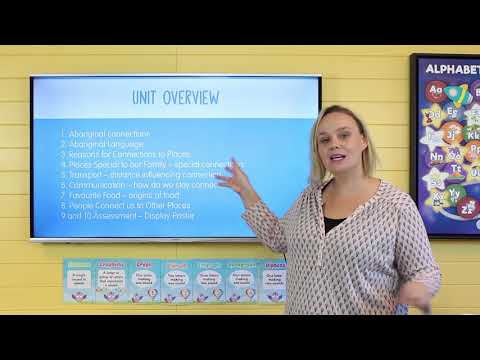
This unit is based on the Year 2 Australian Curriculum HASS Inquiry Skills, Knowledge and Understandings.
Students are introduced to Dreamtime Stories to investigate the connections of the Indigenous Peoples of Australia to the land, sky and waterways. They learn to understand that Aboriginal languages are part of our everyday language.
Students investigate reasons for connections to places, and places that they, and their families, are connected to.
Students explore how we are connected to places through transport, communication and food, and they understand how we maintain those connections with places.
Pose questions about past and present objects, people, places and events
Collect data and information from observations and identify information and data from sources provided
Sort and record information and data, including location, in tables and on plans and labelled maps
Interpret data and information displayed in pictures and texts and on maps
Draw simple conclusions based on discussions, observations and information displayed in pictures and texts and on maps
Present narratives, information and findings in oral, graphic and written forms using simple terms to denote the passing of time and to describe direction and location
The way the world is represented in geographic divisions and the location of Australia in relation to these divisions
The idea that places are parts of Earth’s surface that have been named by people, and how places can be defined at a variety of scales
The ways in which Aboriginal and Torres Strait Islander Peoples maintain special connections to particular Country/Place
The connections of people in Australia to people in other places in Australia and across the world
The influence of purpose, distance and accessibility on the frequency with which people visit places
Demonstrates skills of historical inquiry and communication
Describes features of places and the connections people have with places
Identifies ways in which people interact with and care for places
Communicates geographical information and uses geographical tools for inquiry
Represent data and the location of places and their features by constructing tables, plans and labelled maps
Interpret data and information to draw conclusions and describe the direction and location of places, using terms such as north, south, opposite, near, far
Representation of the location of places and their features on maps and models, including a globe, and the location of the major geographical divisions of the world in relation to Australia
Definition of places as parts of the Earth’s surface that have been given meaning by people, and how places can be defined at a variety of scales
Connections of people in Australia to other places in Australia and across the world
Aboriginal and Torres Strait Islander Country/Place on which the school is located and why Country/Place is important to Aboriginal and Torres Strait Islander peoples, and the ways in which they maintain special connections to particular Country/Place
Activities in the local place and reasons for their location, and the influence of purpose, distance and accessibility on the frequency with which people visit places
Identify the content features of primary sources when describing the significance of people, places or events
Collect and record relevant geographical data and information from the field and secondary sources, using ethical protocols
Students will:
 Lesson 1
Aboriginal Connections
Lesson 1
Aboriginal Connections
In this lesson, students explain the connections that Aboriginal and Torres Strait Islander Peoples feel to the land, sea, sky and waterways.
 Lesson 2
Aboriginal Language
Lesson 2
Aboriginal Language
In this lesson, students recognise the connections between Aboriginal language and our everyday language in Australia, and how this connects us to our cultural history.
 Lesson 3
Reasons For Connections To Places
Lesson 3
Reasons For Connections To Places
In this lesson, students recognise the reasons why we are connected to places, and show connections to a place.
 Lesson 4
Places Special To Our Family
Lesson 4
Places Special To Our Family
In this lesson, students recognise connections for families.
 Lesson 5
Transport
Lesson 5
Transport
In this lesson, students leant to understand how distance can influence our connection. They investigate why we often travel to some places and seldom travel to others and that frequency of travel does not reflect the strength of our connection to those places.
 Lesson 6
Communication
Lesson 6
Communication
In this lesson, students recognise the influence communication has on our connections, and learn to understand the various modes of communication and how these help us stay connected.
 Lesson 7
Favourite Food
Lesson 7
Favourite Food
In this lesson, students learn that food also contributes to our connections. They learn to understand that we are connected to other countries through food.
 Lesson 8
People Connect Us To Other Places
Lesson 8
People Connect Us To Other Places
In this lesson, students learn to understand the connections we have with the world.
 Lesson 9
My Connections To Place
Lesson 9
My Connections To Place
In this lesson, students demonstrate their level of understanding of the connections we have to places. They provide the information yabout the connectionsthey have to places both locally and around the world.
The WALT, WILF & TIB posters were created by request and consist of 14 pages including: WALT - We are learning to... WILF - What I'm...
This banner has been designed to feature along your classroom Word Wall.
This set of blank word wall cards allows you to add vocabulary to your word wall as the need arises. Create your own customised word wall ba...
This presentation has been created to support you throughout the Year 2 HASS Geography Unit - People Have Connections to Places. Simply w...
This fantastic collection includes 10 fantastic landmarks from around Australia. Thank-you to Sue, who kindly donated a lovely photo t...
This fantastic collection includes 34 exciting landmarks displayed here from countries all around the world. Included in the collection...
This 'Recount Outline' was designed for Foundation and Year 1 classrooms to provide a very simple, yet clear, structure to follow when creat...
This presentation looks at the different groups of people in the community and the way we can be connected to others through the groups to w...
These charts perfectly accompany the Transport Flashcards allowing students to sort various forms of transportation into Air, Land or Sea Tr...
This set of flashcards contains 43 various forms of transport.
This presentation features a variety of foods from around the world and has been designed to complement a classroom discussion on the way we...
The World Map was created with the intention of being a fun interpretation that shows where each of the continents of the planet lie and all...
This worksheet is a comprehension activity that can be used with Aboriginal Dreamtime stories.
This worksheet asks students to draw a line connecting each aboriginal word to its meaning. This forms part of our Year 2 HASS Geography...
These postcards allow students to put themselves in the shoes of one of the ANZACs, sending a postcard home to their family to describe the ...
This worksheet requires students to identify the connections they have to other places.
Students look at the various ways they communicate with people they care for in order to stay connected.
Students will match the foods to their countries of origin, recognising food as a way we are connected to other parts of the world. This...
This worksheet looks at the format of an email to a friend, and it includes information about the typical daily life in Japan. We identify e...
This email template has been designed for students to write an email response to a friend from Japan. Students can learn how to construct an...
These worksheets ask students to reflect upon their connections to places around the world. It forms part of the assessment for the Year 2 H...