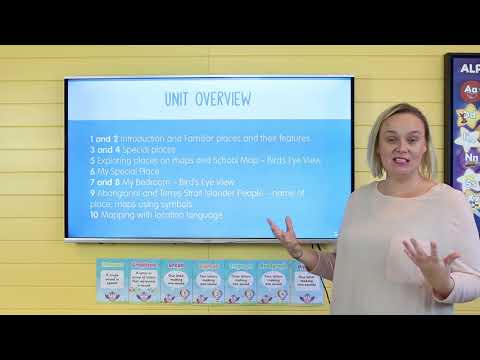
Students explore the place they live in and belong to, and learn to observe and describe its features, and why it is important to them. They explore their own special places, how they feel about them, what makes them special, and how they can care for them (place, environment). They learn that their place is also the place of Aboriginal or Torres Strait Islander Peoples (place). The idea of location is introduced through learning about representations on which places can be located and drawing story maps and creating models to show where familiar places and features are located (space).
Pose questions about past and present objects, people, places and events
Collect data and information from observations and identify information and data from sources provided
Sort and record information and data, including location, in tables and on plans and labelled maps
Compare objects from the past with those from the present and consider how places have changed over time
Interpret data and information displayed in pictures and texts and on maps
Draw simple conclusions based on discussions, observations and information displayed in pictures and texts and on maps
Reflect on learning to propose how to care for places and sites that are important or significant
Demonstrates developing skills of historical inquiry and communication
Identifies places and develops an understanding of the importance of places to people
Communicates geographical information and uses geographical tools
Collect and record geographical data and information from the field and other sources
Represent data and the location of places and their features by constructing tables, plans and labelled maps
Interpret data and information to draw conclusions and describe the direction and location of places, using terms such as north, south, opposite, near, far
In this unit students will learn;
 Lesson 1
Familiar Places and Their Features
Lesson 1
Familiar Places and Their Features
This combined lesson will introduce the geography unit the students will learn about over the next 11 lessons. They will also learn about places that are familiar to them and what the word familiar means.
 Lesson 2
Special Places
Lesson 2
Special Places
In this lesson student's will understand and identify the reasons why a place is special to them.
 Lesson 3
Special Places Sort
Lesson 3
Special Places Sort
Student's will identify and learn that a special place can be important to a single person or a group. They will reinforce this learning with a sorting activity.
 Lesson 4
What is a map
Lesson 4
What is a map
In this lesson, student's learn about maps and bird's eye view.
 Lesson 5
Special Places - Part 1
Lesson 5
Special Places - Part 1
Over the next two lessons, students will design and create their ideal special place.
 Lesson 6
Special Places - Part 2
Lesson 6
Special Places - Part 2
Students will continue to design and create their ideal special place.
 Lesson 7
Map of your Bedroom
Lesson 7
Map of your Bedroom
In this lesson, students will create a map of their bedroom.
 Lesson 8
Aboriginal and Torres Strait Islander Location and Mapping
Lesson 8
Aboriginal and Torres Strait Islander Location and Mapping
This lesson will investigate how their school location is important to the Aboriginal and/or Torres Strait Islander communities and how they create maps using symbols.
 Lesson 9
Mapping Location Language
Lesson 9
Mapping Location Language
In this lesson, students will learn how to give and receive directions using location language, and how to follow these directions to places on a map.
The WALT, WILF & TIB posters were created by request and consist of 14 pages including: WALT - We are learning to... WILF - What I'm...
This Know-Wonder-Learnt poster was designed to use in order to determine student prior knowledge, gauge an interest in what students want to...
The "My Familiar Place - Brainstorm Display Poster" was created to support the 'What is My Place Like?" Foundation Unit Plan. Teachers will...
What Is My Place Like? - Title Page This title page has been designed to support the Foundation HASS Unit Plan - 'What Is My Place'
The 'Wonder Clouds Display' was developed to support your Inquiry Units, allowing students to write down anything they're wondering or would...
The Wonder Wall display header has been developed to be used as a word wall display to introduce vocabulary associated with various units of...
What is my place like? - Wonder Wall Question Display
The 'My Special Place - Brainstorm Display' has been developed to the support the 'What Is My Place?' Foundation Unit Plan for HASS - Geogra...
This set of word wall cards have been created to support the Foundation HASS Geography unit - What Is My Place?
The Birds Eye View – Flash Cards have been created to illustrate the meaning of the phrase, 'birds eye view'. Foundation students will requi...
My Ideal Special Place - Brainstorm Display
This display has been created to support the HASS Geography Foundation Unit Plan - What Is My Place? Teachers will complete the 'My Bedro...
This world map names the continents of the world with a few major countries labeled.
This resource was created to support the Foundation HASS Geography Unit Plan - What Is My Place? The maps feature symbols used to depict...
This resource was created to support the Foundation HASS Geography Unit Plan - What Is My Place? Students will be using this key to ident...
This display features the Australian Torres Strait Islander Flag.
As part of the "What Is My Place?" Foundation Unit Plan, this worksheet requires students to draw a place that is familiar to them and list...
Encourage self-expression and creativity with this reflective resource that invites students to describe and illustrate their special place....
Students will sort various activities by deciding whether they are special places that apply to everyone or just to his/herself.
This Bird's Eye View worksheet requires students to draw a picture of their ideal special place from bird's eye view. The worksheet has b...
Students are required to draw a picture of their bedroom from a bird's eye view as part of the HASS Geography Foundation Unit Plan - What Is...
This worksheet asks students to find the Aboriginal name given to the land on which their school was built. It is part of the Foundation HAS...
This worksheet requires students to find the Torres Strait Islander name given to the land on which their school stands.
This worksheet is part of the Foundation HASS Geography Unit - What Is My Place? Students will be given locational and directional instru...