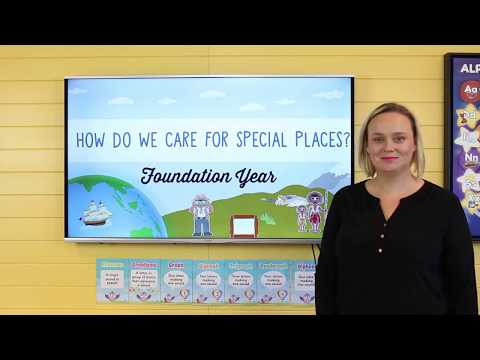
This unit is based on the Foundation Australian Curriculum HASS Inquiry Skills, Knowledge and Understandings.
In this unit, students will learn to explain why places are special and explore caring for special places. They will explore special places within their school, whilst using locational language.
They will use their five senses to observe the features of a place and how they feel about various places. They will discuss how to care for special places, such as the different ways to care for their school.
As part of the inquiry, students will independently make observations of a special place, draw a bird’s eye view map, label its features and design a poster to describe how to care for the special place. They will then use the skills learnt in this unit to discuss and make suggestions on how to care for their home.
Pose questions about past and present objects, people, places and events
Collect data and information from observations and identify information and data from sources provided
Sort and record information and data, including location, in tables and on plans and labelled maps
Sequence familiar objects and events
Explore a point of view
Compare objects from the past with those from the present and consider how places have changed over time
Interpret data and information displayed in pictures and texts and on maps
Draw simple conclusions based on discussions, observations and information displayed in pictures and texts and on maps
Reflect on learning to propose how to care for places and sites that are important or significant
Present narratives, information and findings in oral, graphic and written forms using simple terms to denote the passing of time and to describe direction and location
The representation of the location of places and their features on simple maps and models
The places people live in and belong to, their familiar features and why they are important to people
The reasons why some places are special to people, and how they can be looked after
Demonstrates developing skills of historical inquiry and communication
Identifies places and develops an understanding of the importance of places to people
Communicates geographical information and uses geographical tools
Collect and record geographical data and information from the field and other sources
Represent data and the location of places and their features by constructing tables, plans and labelled maps
Interpret data and information to draw conclusions and describe the direction and location of places, using terms such as north, south, opposite, near, far
Representation of the location of places and their features on maps and models, including a globe, and the location of the major geographical divisions of the world in relation to Australia
Reasons why some places are special and some places are important to people and how they can be looked after
Identify the content features of primary sources when describing the significance of people, places or events
Students will:
 Lesson 1
Caring for Special Places
Lesson 1
Caring for Special Places
Introduction into the unit and exploring what a special place is and looking at special places around the school.
 Lesson 2
Observations using the Five Senses
Lesson 2
Observations using the Five Senses
This lesson looks into how we make observations of the place around us. It also explores how we make these observations using our five senses.
 Lesson 3
Special Place Map
Lesson 3
Special Place Map
This lesson we look at drawing a map using birds-eye-view of a special place at our school.
 Lesson 4
Caring for a Special Place
Lesson 4
Caring for a Special Place
Students will learn about what carinf means and how we can care for our special place.
 Lesson 5
My Special Place at School
Lesson 5
My Special Place at School
Students visit one of the special places around the school that we explored in lesson 1.
 Lesson 6
My Special Place Map
Lesson 6
My Special Place Map
Today the students will create a Birds Eye View map of a special place of their choice from around the school.
 Lesson 7
Create a Poster - Caring for a Special Place
Lesson 7
Create a Poster - Caring for a Special Place
This is the assessment piece of this unit. Students will create a poster over 2 lessons, this poster will be promoting how they can care for their special place.
 Lesson 8
Caring for our Home
Lesson 8
Caring for our Home
In this lesson students will learn how to care for other special places.
 Lesson 9
Helping Hands
Lesson 9
Helping Hands
This lesson we will create helping hands, outlining ways to care for their home.
The WALT, WILF & TIB posters were created by request and consist of 14 pages including: WALT - We are learning to... WILF - What I'm...
This resource was designed to record students wonderings about a unit of work. That is, what questions would they like answered, and what do...
This Know-Wonder-Learnt poster was designed to use in order to determine student prior knowledge, gauge an interest in what students want to...
The Wonder Wall display header has been developed to be used as a word wall display to introduce vocabulary associated with various units of...
This presentation has been created to support you throughout the Foundation HASS Geography Unit - How do we care for special places? Simp...
These charts describe each of the five senses: taste, touch, smell, hearing and sight.
The 'Positional Maths Language Matching Game' has been developed to help students connect the meanings of positional descriptions with the v...
This Brainstorm Display was desgned to use in order to promote classroom discussions. You can write the question on the display and use post...
This is the title page for the Foundation HASS Geography Unit Plan - How Do We Care For Special Places?
This simple worksheet gives students visual prompts for each of their senses to allow them to draw or write their observations of a special...
Students will draw a birds eye view map for the Foundation HASS Geography Unit - How do we care for special places?
Students will draw a place that is special to them and describe how to care for it. This is part of the Foundation HASS Geography Unit -...
Students will list various ways they can care for their home environment. This is part of the Foundation HASS Geography Unit - How do we...
Students will write various ways they can care for their home and illustrate their home, as part of the Foundation HASS Geography Unit - How...