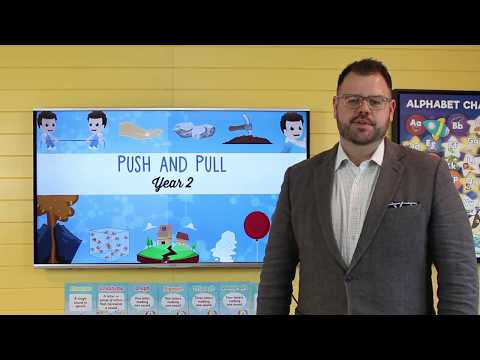
This unit will investigate how the forces of push and pull affect the ways in which objects move on land, water and in the air.
Students explore how the strength of a force affects the movement, explore toys from different cultures and consider the effects of objects being pulled towards the earth.
Describe pushes and pulls in terms of strength and direction and predict the effect of these forces on objects’ motion and shape
Describe how people use science in their daily lives, including using patterns to make scientific predictions
Pose questions to explore observed simple patterns and relationships and make predictions based on experiences
Suggest and follow safe procedures to investigate questions and test predictions
Make and record observations, including informal measurements, using digital tools as appropriate
Sort and order data and information and represent patterns, including with provided tables and visual or physical models
Compare observations with predictions and others’ observations, consider if investigations are fair and identify further questions with guidance
Write and create texts to communicate observations, findings and ideas, using everyday and scientific vocabulary
A push or a pull affects how an object moves or changes shape
Science involves observing, asking questions about, and describing changes in, objects and events
People use science in their daily lives, including when caring for their environment and living things
Pose and respond to questions, and make predictions about familiar objects and events
Participate in guided investigations to explore and answer questions
Use informal measurements to collect and record observations, using digital technologies as appropriate
Use a range of methods to sort information, including drawings and provided tables and through discussion, compare observations with predictions
Compare observations with those of others
Represent and communicate observations and ideas in a variety of ways
Observes, questions and collects data to communicate ideas
Develops solutions to an identified need
Observes the way objects move and relates changes in motion to push and pull forces
Observes, questions and collects data to communicate and compare ideas
Uses materials, tools and equipment to develop solutions for a need or opportunity
Describes, follows and represents algorithms to solve problems
Describes observable features of living things and their environments
Identifies how plants and animals are used for food and fibre products
Identifies that materials can be changed or combined
Describes how the properties of materials determine their use
Describes common forms of energy and explores some characteristics of sound energy
Investigates how forces and energy are used in products
Recognises observable changes occurring in the sky and on the land and identifies Earth’s resources
Identifies the components of digital systems and explores how data is represented
People use science in their daily lives
The way objects move depends on a variety of factors including their size and shape: a push or a pull affects how an object moves or changes shape
Respond to and pose questions, and make predictions about familiar objects and events
Participate in guided investigations, including making observations using the senses, to explore and answer questions
Use informal measurements in the collection and recording of observations
Use a range of methods, including drawings and provided tables, to sort information
Compare observations and predictions with those of others
Represent and communicate observations and ideas about changes in objects and events in a variety of ways
In this unit, students:
 Lesson 1
Push
Lesson 1
Push
In this lesson students will explore the force of push and how it moves objects.
 Lesson 2
Pull
Lesson 2
Pull
In this lesson students will explore the force of pull and how it moves objects.
 Lesson 3
Gravity
Lesson 3
Gravity
In this lesson students explore the force of gravity and how it moves objects.
 Lesson 4
Forces affect an object’s shape
Lesson 4
Forces affect an object’s shape
In this lesson students will investigate how forces can change the shape of an object and why.
 Lesson 5
The amount of force
Lesson 5
The amount of force
In this lesson students investigate the amount of force needed to move an object can change.
 Lesson 6
How objects move in water
Lesson 6
How objects move in water
In this lesson students will learn about the push of water and the pull of gravity.
 Lesson 7
How objects move in air
Lesson 7
How objects move in air
In this lesson students will investigate how objects move through the air and the forces applied to the object.
 Lesson 8
Toys from around the world
Lesson 8
Toys from around the world
In this lesson students will explored the toys from different countries and cultures and the forces that are used when playing with them.
 Lesson 9
Design Challenge Assessment
Lesson 9
Design Challenge Assessment
In this lesson students will design a transporter.
The WALT, WILF & TIB posters were created by request and consist of 14 pages including: WALT - We are learning to... WILF - What I'm...
A Poster shows some of the types of movement This poster shows the different types of movement
This banner has been designed to feature along your classroom Word Wall.
This set of blank word wall cards allows you to add vocabulary to your word wall as the need arises. Create your own customised word wall ba...
Students will learn about the different types of forces that can be exerted by one object on another. They will learn about non-contact forc...
A Poster that shows the forces that act on an object in water. This poster can help explain the forces of buoyancy
A final assessment task where students design an item to move a toy bear from the bottom to the top of the hill, understanding all the force...
During this worksheet, students identify and describe a push force. This worksheet will help students understand the direction of force f...
During this worksheet, students identify and describe a Pull force. This worksheet will help students understand the direction of force f...
Students cut, sort and paste items that are pushed and pulled to help cement and check their understanding of push/pull forces. This work...
During this worksheet, students identify and describe the force of gravity. This worksheet will help students understand the direction of...
Ignite students' curiosity about space and gravity with this thought-provoking worksheet. Students will calculate and compare their weight o...
Students experiment with the way forces can change the shape of an item, and begin to investigate the importance of materials to resist thes...
Sheet outlines 4 activities tat students will complete in small groups to better understand how the amount of force impacts the movement of...
Workbook for 4 activities tat students will complete in small groups to better understand how the amount of force impacts the movement of ob...
A wordsearch for early finishers. This is a worksheet that can be used for early finishers during the push/pull unit
Engage students in a captivating experiment exploring the forces acting on water with this worksheet. Students will conduct hands-on experim...
The paper plane template has been designed for young students to colour and fold their very own paper planes. This forms part of the Foun...
During this activity, students learn about, and compare toys from around the world (including traditional aboriginal toys) with their favour...