This unit is based on the Year 5 Australian Curriculum HASS Inquiry Skills, Knowledge and Understandings.
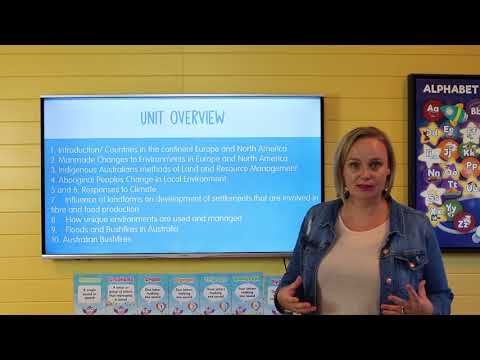
Students explore the countries and manmade changes of both Europe and North America.
They explore the Indigenous Australians' methods of land and resource management and how the biodiversity of Australia drastically changed after European Settlement.
Students investigate liveability and complete an information report on one of the effects of climate change and the way it impacts liveability.
They explore the influence of landforms on the development of settlements that are involved in fibre and food production, specifically focusing on the Ganges, Yangtze, Amazon and Mekong Rivers.
They explore the unique environment of Antarctica and how it is used and managed through exploring the Antarctic Treaty and Antarctic settlements.
Students explore the locations in which floods and bushfires occur, focusing on the severity, impacts and prevention in Australia.
Develop appropriate questions to guide an inquiry about people, events, developments, places, systems and challenges
Locate and collect relevant information and data from primary sources and secondary sources
Organise and represent data in a range of formats including tables, graphs and large- and small-scale maps, using discipline-appropriate conventions
Examine primary sources and secondary sources to determine their origin and purpose
Examine different viewpoints on actions, events, issues and phenomena in the past and present
Interpret data and information displayed in a range of formats to identify, describe and compare distributions, patterns and trends, and to infer relationships
Evaluate evidence to draw conclusions
Work in groups to generate responses to issues and challenges
Use criteria to make decisions and judgements and consider advantages and disadvantages of preferring one decision over others
Reflect on learning to propose personal and/or collective action in response to an issue or challenge, and predict the probable effects
Present ideas, findings, viewpoints and conclusions in a range of texts and modes that incorporate source materials, digital and non-digital representations and discipline-specific terms and conventions
The influence of people on the environmental characteristics of places in Europe and North America and the location of their major countries in relation to Australia
The influence of people, including Aboriginal and Torres Strait Islander Peoples, on the environmental characteristics of Australian places
The environmental and human influences on the location and characteristics of a place and the management of spaces within them
The impact of bushfires or floods on environments and communities, and how people can respond
Applies a variety of skills of historical inquiry and communication
Describes the diverse features and characteristics of places and environments
Explains interactions and connections between people, places and environments
Compares and contrasts influences on the management of places and environments
Acquires, processes and communicates geographical information using geographical tools for inquiry
Collect and record relevant geographical data and information from the field and secondary sources, using ethical protocols
Represent the location of places and other types of geographical data and information in different forms including diagrams, field sketches and large-scale and small-scale maps that conform to cartographic conventions of border, scale, legend, title, north point and source; using digital and spatial technologies as appropriate
Interpret maps and other geographical data and information using digital and spatial technologies as appropriate, to develop identifications, descriptions, explanations and conclusions that use geographical terminology
Location of the major countries of Europe and North America, in relation to Australia and their major characteristics including the influence of people on the environmental characteristics of places in at least two countries from both continents
Influence of people, including the influence of Aboriginal and Torres Strait Islander peoples, on the environmental characteristics of Australian places
Impacts of bushfires or floods on environments and communities, and how people can respond
Environmental and human influences on the location and characteristics of places and the management of spaces within them
Identify the origin, content features and the purpose of historical sources and describe the context of these sources when explaining daily life in colonial Australia, reasons for migration and causes and effects of Federation
The key concepts in this unit include:
 Lesson 1
Countries Of Europe And North America
Lesson 1
Countries Of Europe And North America
In this lesson, students locate and name the countries within the continents of Europe and North America.
 Lesson 2
Manmade Changes To Environments In Europe And North America
Lesson 2
Manmade Changes To Environments In Europe And North America
In this lesson students explore manmade changes to an environment in Europe and North America. They explore the Floating City of Venice, and the Hoover Dam.
 Lesson 3
Indigenous Australians Methods Of Land And Resource Management
Lesson 3
Indigenous Australians Methods Of Land And Resource Management
In this lesson students explore Indigenous Australians methods of land and resource management. They describe and explain how Indigenous Australians managed the landscape for food, shelter and clothing.
 Lesson 4
Aboriginal Peoples Change In Local Environment
Lesson 4
Aboriginal Peoples Change In Local Environment
In this lesson, students investigate biodiversity, and life before and after European settlement for Indigenous Australians.
 Lesson 5
Responses To Climate
Lesson 5
Responses To Climate
In this lesson, students investigate climate factors that impact liveability.
 Lesson 6
Influence Of Landforms On Development Of Settlements
Lesson 6
Influence Of Landforms On Development Of Settlements
In this lesson, students explore how landforms influence settlement, population and production of food and fibre.
 Lesson 7
How Unique Environments Are Used And Managed
Lesson 7
How Unique Environments Are Used And Managed
In this lesson, students explore the unique environment of Antarctica. They explore settlement and human use of Antarctica and the practices and laws that aim to manage human impact.
 Lesson 8
Floods And Bushfires In Australia
Lesson 8
Floods And Bushfires In Australia
In the lesson, students explore floods and bushfires location, severity, and impacts .
 Lesson 9
Australian Bushfires
Lesson 9
Australian Bushfires
In this lesson, students explore bushfires and flood safety and preparation.
The WALT, WILF & TIB posters were created by request and consist of 14 pages including: WALT - We are learning to... WILF - What I'm...
This presentation has been created to support you throughout the Year 5 HASS Geography Unit - Impacts on Environment. Simply work through...
This worksheet was designed to be used a an individual graphic organiser for students to record what they already know about a unit, what th...
Students are asked to label the European countries on the map. This forms part of the Year 5 HASS Geography Unit - Impacts on Environment...
Students compare Aboriginal life before and after colonisation. This activity forms part of the Year 5 HASS History Unit - Exploring Aust...
Students examine the ways a number of factors are affecting sustainability. This forms part of the Year 5 HASS Geography Unit - Impacts o...
Students examine the similarities and differences in the way people lived in the past and the way they live today. This forms part of the...
Students will look at the various effects of climate change and how they have occurred. This forms part of the Year 5 HASS Geography Unit...
Students will understand how various landforms affect the positioning of settlements and urbanisation. This forms part of the Year 5 HASS...
Students will research a river and understand how the river influenced settlement in the surrounding area. This forms part of the Year 5...
Students will complete an information report on the Antarctic Treaty. This forms part of the Year 5 HASS Geography Unit - Impacts on Envi...
Students will complete the Venn Diagram comparing the life of an Antarctic settlement to that of their own daily lives. This forms part o...
Examine the natural phenomenon of flooding in Australia with this engaging worksheet. Students will learn about the causes and impacts of fl...
Students will colour and label a map of Australia to show where bushfires typically occur throughout our country. This forms part of the...
Students will create a comic strip that explains how to prepare for a natural disaster. This forms part of the Year 5 HASS Geography Unit...