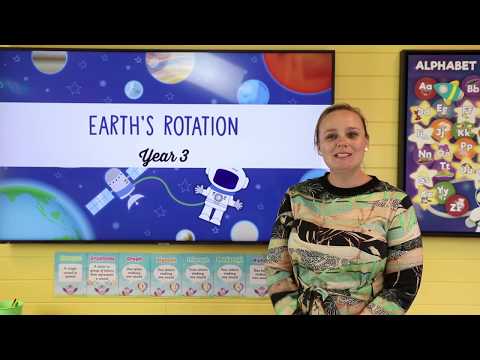
This is a ten-lesson unit that is designed to cover the Australian National Curriculum for Year 3 - Earth and Space Sciences. Over the course of this unit, students will develop an understanding that the earth’s rotation on its axis causes regular changes. They make predictions, observations, experiment and create graphs in relation to day and night, shadows, using the sun to tell time (sundials), seasons, solar and lunar eclipses.
Earth’s rotation on its axis causes regular changes, including night and day
Science involves making predictions and describing patterns and relationships
With guidance, identify questions in familiar contexts that can be investigated scientifically and make predictions based on prior knowledge
With guidance, plan and conduct scientific investigations to find answers to questions, considering the safe use of appropriate materials and equipment
Consider the elements of fair tests and use formal measurements and digital technologies as appropriate, to make and record observations accurately
Use a range of methods including tables and simple column graphs to represent data and to identify patterns and trends
Compare results with predictions, suggesting possible reasons for findings
Reflect on investigations, including whether a test was fair or not
Represent and communicate observations, ideas and findings using formal and informal representations
Questions, plans and conducts scientific investigations, collects and summarises data and communicates using scientific representations
Selects and uses materials, tools and equipment to develop solutions for a need or opportunity
Defines problems, describes and follows algorithms to develop solutions
Compares features and characteristics of living and non-living things
Describes how agricultural processes are used to grow plants and raise animals for food, clothing and shelter
Describes how adding or removing heat causes a change of state
Investigates the suitability of natural and processed materials for a range of purposes
Describes the characteristics and effects of common forms of energy, such as light and heat
Describes how contact and non-contact forces affect an object’s motion
Investigates regular changes caused by interactions between the Earth and the Sun, and changes to the Earth’s surface
Describes how digital systems represent and transmit data
With guidance, identify questions in familiar contexts that can be investigated scientifically and predict what might happen based on prior knowledge
Suggest ways to plan and conduct investigations to find answers to questions including consideration of the elements of fair tests
Safely use appropriate materials, tools, equipment and technologies
Use formal measurements in the collection and recording of observations
Use a range of methods including tables and column graphs to represent data and to identify patterns and trends
Compare results with predictions, suggesting possible reasons for findings
Reflect on an investigation, including whether a test was fair or not
Represent and communicate observations, ideas and findings to show patterns and relationships using formal and informal scientific language
 Lesson 1
Observable Features in the Earth's Sky
Lesson 1
Observable Features in the Earth's Sky
In this lesson, students learn about the earth's rotation and the regular changes that this can cause.
 Lesson 2
Day and Night
Lesson 2
Day and Night
Students will learn what causes day and night.
 Lesson 3
Shadows
Lesson 3
Shadows
Students will explore shadows and how they are formed.
 Lesson 4
Sun O'Clock
Lesson 4
Sun O'Clock
In this lesson, students will look at how the sun can be used to tell the time.
 Lesson 5
Seasons
Lesson 5
Seasons
This lesson will look at the earth's rotation and orbit around the sun which causes different seasons.
 Lesson 6
Mr Moon
Lesson 6
Mr Moon
Students will investigate the earth and sun's relationship with the moon.
Use the Time of Day Display to sequence familiar events in time order and to understand the differences in the appearance of the sky at vari...
The 'Wonder Clouds Display' was developed to support your Inquiry Units, allowing students to write down anything they're wondering or would...
The Wonder Wall display header has been developed to be used as a word wall display to introduce vocabulary associated with various units of...
These space themed WALT, WILF, and TIB posters are perfect for earth and space sciences units.
Poster explains how an axis is an imaginary straight line that runs through the North Pole, earth’s centre and the South Pole. The axis is t...
A poster that explains that we see the sun rise in the east and set in the west.
A poster that visually demonstrates how the sun causes shadows.
A poster that visually demonstrates how shadows occur, and how they move throughout the day.
Coloured poster/ banner of timeline showing the seasons and months in the southern hemisphere. Display poster in class when looking at se...
A poster that visually demonstrates how the seasons occur in the southern hemisphere.
A poster that explains how for part of the year the southern hemisphere is tilted towards the sun, this is when we are in direct sunlight. W...
A poster that explains that for part of the year the southern hemisphere is tilted away from the sun, this is when we are in indirect sunlig...
A poster that explains the moon’s orbit, and that it takes 27 days for the moon to orbit the earth.
Students record what they already know about the earth, moon and sun. They draw and annotate a scientific diagram to show their understandi...
Students record some things that they have observed in the day and night in relation to the sun, moon and earth.
Students draw a scientific diagram of the earth’s rotation on its axis and how this causes day and night. They include annotations.
Students investigate/ observe the shadow of An object throughout the day. Students make predictions. They record length and direction of the...
This worksheet is used to record sundial observations and to draw a diagram of your sundial with labels.
Students research the average temperature of their local area for each month, and plot on the line graph. They record the names of the seas...
Students draw a scientific diagram with annotations to show their understanding of how the earth’s rotation on it’s axis, and its orbit arou...
Students use their knowledge of how a total lunar eclipse occurs, and draw a diagram with annotations to illustrate their prediction of what...