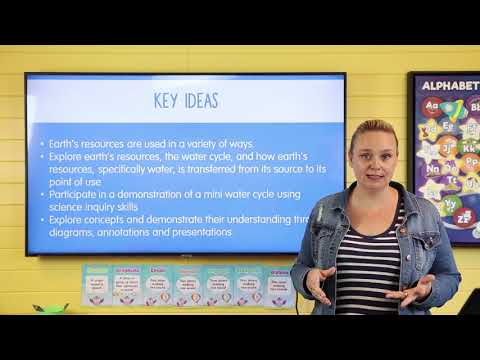
This unit that is designed to cover the Australian National Curriculum for Year 2 - Earth and Space Sciences. Throughout this unit, students will develop an understanding that Earth’s resources are used in a variety of ways. Students explore Earth’s resources, the water cycle, and how Earth’s resources, specifically water, is transferred from its source to use. Students participate in a demonstration of a mini water cycle using science inquiry skills. They explore concepts and demonstrate their understanding through diagrams, annotations and presentations.
Earth’s resources are used in a variety of ways
Science involves observing, asking questions about, and describing changes in, objects and events
People use science in their daily lives, including when caring for their environment and living things
Pose and respond to questions, and make predictions about familiar objects and events
Participate in guided investigations to explore and answer questions
Use informal measurements to collect and record observations, using digital technologies as appropriate
Use a range of methods to sort information, including drawings and provided tables and through discussion, compare observations with predictions
Compare observations with those of others
Represent and communicate observations and ideas in a variety of ways
Observes, questions and collects data to communicate and compare ideas
Uses materials, tools and equipment to develop solutions for a need or opportunity
Describes, follows and represents algorithms to solve problems
Describes observable features of living things and their environments
Identifies how plants and animals are used for food and fibre products
Identifies that materials can be changed or combined
Describes how the properties of materials determine their use
Describes common forms of energy and explores some characteristics of sound energy
Investigates how forces and energy are used in products
Recognises observable changes occurring in the sky and on the land and identifies Earth’s resources
Identifies the components of digital systems and explores how data is represented
People use science in their daily lives
Earth’s resources are used in a variety of ways
Respond to and pose questions, and make predictions about familiar objects and events
Participate in guided investigations, including making observations using the senses, to explore and answer questions
Use informal measurements in the collection and recording of observations
Use a range of methods, including drawings and provided tables, to sort information
Compare observations and predictions with those of others
Represent and communicate observations and ideas about changes in objects and events in a variety of ways
 Lesson 1
Observable Features in the Earth’s Sky
Lesson 1
Observable Features in the Earth’s Sky
In this lesson we thought about the things we already know about Earth’s resources, and what we wonder about them.
 Lesson 2
Earth’s Resources in our School
Lesson 2
Earth’s Resources in our School
In this lesson, we explored how we use the Earth’s resources in our school.
 Lesson 3
Predictions
Lesson 3
Predictions
In this lesson, we explored what life would be like if we ran out of one of Earth’s resources.
 Lesson 4
Conserving Earth’s Resources
Lesson 4
Conserving Earth’s Resources
In this lesson, we explored how we can conserve one of Earth’s resources in our school.
 Lesson 5
Turn on the Tap
Lesson 5
Turn on the Tap
In this lesson, we began exploring how one of Earth’s resources, water, is transferred from its source to its point of use. We specifically learnt about the water cycle.
 Lesson 6
Water Source to Tap
Lesson 6
Water Source to Tap
In this lesson, we continued exploring how one of Earth’s resources, water, is transferred from its source to its point of use. We specifically looked at groundwater as a source.
 Lesson 7
Catchment to Tap
Lesson 7
Catchment to Tap
In this lesson, we continued exploring how one of Earth’s resources, water, is transferred from its source to its point of use. We specifically looked at catchments as a source.
 Lesson 8
Ocean to Tap
Lesson 8
Ocean to Tap
In this lesson, we continued exploring how one of Earth’s resources, water, is transferred from its source to its point of use. We specifically looked at the ocean as a source.
 Lesson 9
Local Water Source
Lesson 9
Local Water Source
In this lesson student's will take an excursion to a dam, treatment plant or desalination plant.
 Lesson 10
Presentation – From Source to Tap
Lesson 10
Presentation – From Source to Tap
In this lesson, students will create a presentation that explains how water is transferred from a source to tap.
This resource was designed to record students wonderings about a unit of work. That is, what questions would they like answered, and what do...
The Wonder Wall display header has been developed to be used as a word wall display to introduce vocabulary associated with various units of...
These space themed WALT, WILF, and TIB posters are perfect for earth and space sciences units.
This worksheet was designed to be used a an individual graphic organiser for students to record what they already know about a unit, what th...
Students cut, match and paste the law/regulation to the appropriate enforcement. This worksheet is part of a larger unit on Australian vo...