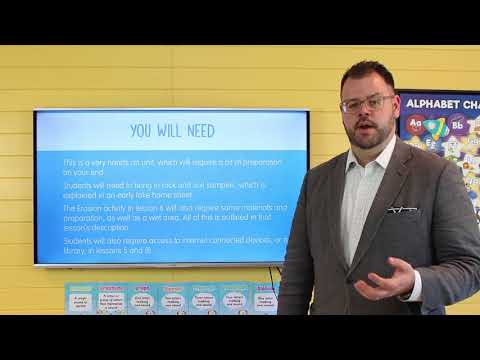
This is a 10 lesson unit, designed to cover the Australian Curriculum for Year 4 Earth and Space Sciences.
Over the course of this unit, students learn how the surface of the earth changes over time due to weathering and erosion. Students get hands-on experience investigating and sorting rock and soil samples, and they investigate the role that we play in shaping how erosion happens.
Students will zoom in on the tiniest crystals in a rock and zoom out as far as we can go, using Google Earth to visit extraordinary examples of geological change around the world.
Each lesson has an accompanying activity worksheet for students to complete, and there is a quiz that can be used as a summative assessment task at the end of the unit.
Examine how people use data to develop scientific explanations
Consider how people use scientific explanations to meet a need or solve a problem
Pose questions to explore observed patterns and relationships and make predictions based on observations
Use provided scaffolds to plan and conduct investigations to answer questions or test predictions, including identifying the elements of fair tests, and considering the safe use of materials and equipment
Follow procedures to make and record observations, including making formal measurements using familiar scaled instruments and using digital tools as appropriate
Construct and use representations, including tables, simple column graphs and visual or physical models, to organise data and information, show simple relationships and identify patterns
Compare findings with those of others, consider if investigations were fair, identify questions for further investigation and draw conclusions
Write and create texts to communicate findings and ideas for identified purposes and audiences, using scientific vocabulary and digital tools as appropriate
Describe how weathering, erosion, transportation and deposition cause slow or rapid change to Earth’s surface
Earth’s surface changes over time as a result of natural processes and human activity
Science involves making predictions and describing patterns and relationships
Science knowledge helps people to understand the effect of their actions
With guidance, identify questions in familiar contexts that can be investigated scientifically and make predictions based on prior knowledge
With guidance, plan and conduct scientific investigations to find answers to questions, considering the safe use of appropriate materials and equipment
Consider the elements of fair tests and use formal measurements and digital technologies as appropriate, to make and record observations accurately
Use a range of methods including tables and simple column graphs to represent data and to identify patterns and trends
Compare results with predictions, suggesting possible reasons for findings
Reflect on investigations, including whether a test was fair or not
Represent and communicate observations, ideas and findings using formal and informal representations
Questions, plans and conducts scientific investigations, collects and summarises data and communicates using scientific representations
Selects and uses materials, tools and equipment to develop solutions for a need or opportunity
Defines problems, describes and follows algorithms to develop solutions
Compares features and characteristics of living and non-living things
Describes how agricultural processes are used to grow plants and raise animals for food, clothing and shelter
Describes how adding or removing heat causes a change of state
Investigates the suitability of natural and processed materials for a range of purposes
Describes the characteristics and effects of common forms of energy, such as light and heat
Describes how contact and non-contact forces affect an object’s motion
Investigates regular changes caused by interactions between the Earth and the Sun, and changes to the Earth’s surface
Describes how digital systems represent and transmit data
Science knowledge helps people to understand the effects of their actions
Earth’s surface changes over time as a result of natural processes and human activity
With guidance, identify questions in familiar contexts that can be investigated scientifically and predict what might happen based on prior knowledge
Safely use appropriate materials, tools, equipment and technologies
Use formal measurements in the collection and recording of observations
Use a range of methods including tables and column graphs to represent data and to identify patterns and trends
Compare results with predictions, suggesting possible reasons for findings
Reflect on an investigation, including whether a test was fair or not
Represent and communicate observations, ideas and findings to show patterns and relationships using formal and informal scientific language
In this unit, students:
 Lesson 1
The Earths Makeup
Lesson 1
The Earths Makeup
In this lesson, students talk about the layers of the earth, and how the earth’s crust that we’re on is always changing, by moving around and banging into other pieces.
 Lesson 2
Rocks
Lesson 2
Rocks
In this lesson, students learn about the three types of rocks, how they’re formed, and how we can tell them apart.
 Lesson 3
Rock Sorting
Lesson 3
Rock Sorting
In this lesson, students work as teams to sort through rock samples, and using their powers of observation, and scientific knowledge, they make informed scientific guesses about what types of rocks they are looking at, the same way geologists do.
 Lesson 4
Soil
Lesson 4
Soil
In this lesson, students look at the parts of soil, and how scientists classify different types of soil. They also start an experiment on soil that they will look at again in a few weeks
 Lesson 5
Natural Erosion
Lesson 5
Natural Erosion
In tis lesson, students explore how natural forces, like climate, rivers, and glaciers can change the surface of the earth.
 Lesson 6
Erosion Experiment
Lesson 6
Erosion Experiment
In this lesson, students explore how nature can change landscapes through erosion.
 Lesson 7
Human Caused Change
Lesson 7
Human Caused Change
In this lesson, students learn about how we’ve impacted erosion, and how we can change and minimise our impact.
 Lesson 8
Extreme Events
Lesson 8
Extreme Events
In this lesson studunts will explore extreme weather events and the effect they have on the surface of the earth.
 Lesson 9
Examining Soil
Lesson 9
Examining Soil
In this lesson, students take a second look at their soil samples, now that they’ve settled into distinct layers. They measure and estimate the amount of the different ingredients in our soil, and classify it like a geologist would.
 Lesson 10
Surface Change Assessment
Lesson 10
Surface Change Assessment
In this lesson, students finish the science unit by completing a short quiz, demonstrating all they've learned about erosion and weathering.
This visual cross section of Earth provides approximate distances from the Earth's crust to the centre of the planet. Approximate sizes of e...
The WALT, WILF & TIB posters were created by request and consist of 14 pages including: WALT - We are learning to... WILF - What I'm...
This PowerPoint presentation explains the three types of rocks, how they’re formed, and how they can be identified. This presentation can...
This poster defines igneous, sedimentary and metamorphic rocks as well as looking at minerals. It aims to provide a simple definition for ea...
This PowerPoint presentation explains the different types of soil and how scientists classify soil types. This presentation can be used t...
This PowerPoint presentation explains the natural process of weathering and erosion, and how they change the surface of the earth. This p...
This PowerPoint presentation explains the effect of humans on weathering and erosion, both positive and negative. This presentation can b...
This PowerPoint presentation illustrates how natural disasters and dramatic weather events can also change the surface of the earth. This...
Students learn about continental drift and plate tectonics by moving backwards in time taking our current continents and creating Pangea....
Students take home a worksheet that gives them and their carers instructions on how to collect a soil and rock sample. Helping students u...
Students cut, rearrange and paste a series of rock facts into their science books that will help them understand the differences between the...
Students examine rock samples and try to sort and classify them. Increasing students’ understanding of the differences between the 3 dif...
Students do an analysis of dry soil samples, and prepare their samples for a future investigation. Through investigation, students learn...
Students use Google Earth to explore landmarks created through weathering and erosion This activity allows students to investigate the ma...
Students watch erosion happen, in a model of a landscape that they’ve created. This investigation allows students to observe and describe...
Students research a natural disaster, and use that knowledge to create a before and after image of the change to the earth’s surface. ...
This is a continuation to the previous soil investigation, that now let’s students look at the soil samples after sitting in solution over a...