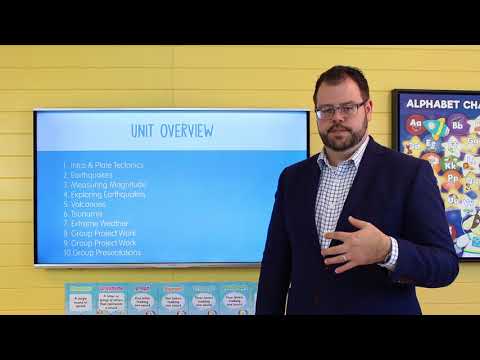
In this unit, designed to last 10 lessons, students will complete the Year 6 ACARA Earth and Space Sciences curriculum, which focuses on natural disasters and extreme climate events.
The final piece of the unit is a group project and presentation, which may take more than one block of class time, and you may want to incorporate the project into your literacy time, condense (lessons 2 & 3) or omit (lesson 8) earlier lessons to compensate.
The presentation itself will be modelled in lesson 4, where you will complete a similar presentation about an earthquake.
Sudden geological changes and extreme weather events can affect Earth’s surface
Science involves testing predictions by gathering data and using evidence to develop explanations of events and phenomena and reflects historical and cultural contributions
Scientific knowledge is used to solve problems and inform personal and community decisions
With guidance, pose clarifying questions and make predictions about scientific investigations
Identify, plan and apply the elements of scientific investigations to answer questions and solve problems using equipment and materials safely and identifying potential risks
Decide variables to be changed and measured in fair tests, and observe measure and record data with accuracy using digital technologies as appropriate
Construct and use a range of representations, including tables and graphs, to represent and describe observations, patterns or relationships in data using digital technologies as appropriate
Compare data with predictions and use as evidence in developing explanations
Reflect on and suggest improvements to scientific investigations
Communicate ideas, explanations and processes using scientific representations in a variety of ways, including multi-modal texts
Plans and conducts scientific investigations to answer testable questions, and collects and summarises data to communicate conclusions
Plans and uses materials, tools and equipment to develop solutions for a need or opportunity
Defines problems, and designs, modifies and follows algorithms to develop solutions
Examines how the environment affects the growth, survival and adaptation of living things
Explains how food and fibre are produced sustainably in managed environments for health and nutrition
Explains the effect of heat on the properties and behaviour of materials
Explains how the properties of materials determines their use for a range of purposes
Explains how energy is transformed from one form to another
Investigates the effects of increasing or decreasing the strength of a specific contact or non-contact force
Explains regular events in the solar system and geological events on the Earth’s surface
Explains how digital systems represent data, connect together to form networks and transmit data
Scientific understandings, discoveries and inventions are used to inform personal and community decisions and to solve problems that directly affect people’s lives
With guidance, pose questions to clarify practical problems or inform a scientific investigation, and predict what the findings of an investigation might be based on previous experiences or general rules
With guidance, plan appropriate investigation types to answer questions or solve problems and use equipment, technologies and materials safely, identifying potential risks
Decide which variables should be changed, measured and controlled in fair tests and accurately observe, measure and record data
Construct and use a range of representations, including tables and graphs, to record, represent and describe observations, patterns or relationships in data
Compare data with predictions and use as evidence in developing explanations
Suggest improvements to the methods used to investigate a question or solve a problem
Communicate ideas and processes using evidence to develop explanations of events and phenomena and to identify simple cause-and-effect relationships
In this unit, students:
 Lesson 1
Intro and Plate Tectonics
Lesson 1
Intro and Plate Tectonics
In this lesson, students explore the different layers of the earth, and focused on the crust. This includes, the thinnest layer, the crust, which is made up of a jigsaw of floating tectonic plates.
 Lesson 2
Earthquakes
Lesson 2
Earthquakes
In this lesson, students learn that when plates move across or towards each other, they can release energy in the form of earthquakes.
 Lesson 3
Measuring Magnitude
Lesson 3
Measuring Magnitude
In this lesson, students investigate how scientists measure and study earthquakes, and why they
do it.
 Lesson 4
Exploring Earthquakes
Lesson 4
Exploring Earthquakes
In this lesson, students watch an example of a presentation similar to the ones they will be starting in a few weeks.They also discuss how scientists and engineers design buildings to keep people safe in earthquake zones, and then have a go at designing one themselves.
 Lesson 5
Volcanoes
Lesson 5
Volcanoes
In this lesson, students work through the volcanoes presntation and they creat a 3D model of a volcano.
 Lesson 6
Tsunamis
Lesson 6
Tsunamis
In this lesson, students discuss Tsunamis, how they’re formed, and the damage that they do. They explore the 2004 Boxing Day Tsunami.
 Lesson 7
Extreme Weather
Lesson 7
Extreme Weather
In this lesson, students explore the various extreme weather events that have the power tochange the surface of the earth and impact those of us who live here. They also investigate how climate change is impacting the frequency and severity of extreme weather events.
 Lesson 8
Historical Disaster Assessment
Lesson 8
Historical Disaster Assessment
This assessment will span over 2 lessons. In groups, students will pick a natural disaster and create a presentation, which they will present to the class.
The WALT, WILF & TIB posters were created by request and consist of 14 pages including: WALT - We are learning to... WILF - What I'm...
The WALT, WILF, WAGOLL & TIB posters were created to support our Beach classroom theme and include: WALT - We are learning to... WIL...
The WALT, WILF, WAGOLL & TIB posters were created to support our Ninja classroom theme and include: WALT - We are learning to... WIL...
The WALT, WILF, WAGOLL & TIB posters were created to support our Popart classroom theme and include: WALT - We are learning to... WI...
The WALT, WILF, WAGOLL & TIB posters were created to support our Superhero classroom theme and include: WALT - We are learning to......
This poster was designed to be used a an individual or whole class graphic organiser for students to record what they already know about a u...
This final assessment piece is a group presentation on a large scale natural disaster. Assessing students’ understanding of the causes an...
In this presentation, students learn the basic structure of the earth, and that this structure is what causes disasters In this presentat...
In this presentation, students learn how the movement of plates towards, away, and across one another cause earthquakes This presentation...
In this presentation, students learn how scientists measure the strength of earthquakes through seismography This presentation can be use...
This presentation models the classroom presentation that students will have to do for their assessment, and also discusses how buildings in...
Students complete a 3D model of a stratovolcano (composite cone volcano) Students develop an understanding of the internal structures of...
In this presentation, students learn about volcanoes, how they’re formed, and their impact on the surface of the earth. This presentation...
This presentation can be used to teach the year 6 Earth and Spaces Sciences Curriculum. This presentation can be used to teach the year 6...
In this presentation, students learn about the different forms of extreme weather (Cyclones, Tornadoes, Floods, Droughts, and Fires) and the...
Enhance students' scientific literacy with this comprehensive science glossary. This resource provides a compilation of key scientific terms...
This worksheet goes over some of earth's natural disasters. The worksheet also contains an activity to create a KWL about natural disasters.
Introduce the concept of waves in a dynamic and interactive way with this teacher worksheet. Using a slinky, students can explore and observ...
In this activity, students use pieces of plasticine to visualise how plates collide along tectonic boundaries Helping students visualise...
This final assessment piece is a group presentation on a large scale natural disaster. Assessing students’ understanding of the causes an...
Students investigate how buildings are designed to incorporate earthquake mitigation, and design their own building for an earthquake prone...
This activity helps students understand the devastation of the 2004 boxing day tsunami, as well as how and why it impact a number of countri...
In this activity students look at real world ocean temperature data to try and understand how our changing climate may be affecting the seve...