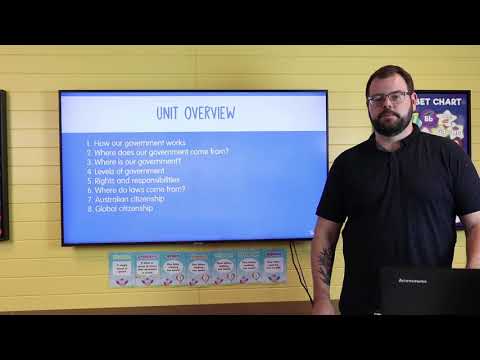
This unit is based on the Year 6 Australian Curriculum HASS Civics and Citizenships Knowledge and Understandings. This unit is content heavy, but we have tried to lighten it up with some fun activities and interesting presentations. This unit is a great introduction to the political system before a trip to Canberra. It is worth considering doing after our history unit as well, as the stronger a student’s understanding of federation, the easier some concepts will be.
Some of this content will have been covered before, in previous years (levels of government in year 4, voting in year 5) and some of it overlaps with other HASS units you may have done this year (History). While it never hurts to go over something more than once, it might be beneficial to check the understanding of your group and adjust your speed accordingly. There are more activities than there are lessons, so feel free to stretch out the activities, or cut some, as required in your classroom.
Develop appropriate questions to guide an inquiry about people, events, developments, places, systems and challenges
Locate and collect relevant information and data from primary sources and secondary sources
Organise and represent data in a range of formats including tables, graphs and large- and small-scale maps, using discipline-appropriate conventions
Examine different viewpoints on actions, events, issues and phenomena in the past and present
Interpret data and information displayed in a range of formats to identify, describe and compare distributions, patterns and trends, and to infer relationships
Evaluate evidence to draw conclusions
Work in groups to generate responses to issues and challenges
Use criteria to make decisions and judgements and consider advantages and disadvantages of preferring one decision over others
Reflect on learning to propose personal and/or collective action in response to an issue or challenge, and predict the probable effects
Present ideas, findings, viewpoints and conclusions in a range of texts and modes that incorporate source materials, digital and non-digital representations and discipline-specific terms and conventions
Key figures, events and ideas that led to Australia’s Federation and Constitution
Experiences of Australian democracy and citizenship, including the status and rights of Aboriginal and Torres Strait Islander Peoples, migrants, women and children
The key institutions of Australia’s democratic system of government and how it is based on the Westminster system
The roles and responsibilities of Australia’s three levels of government
The responsibilities of electors and representatives in Australia’s democracy
Where ideas for new laws can come from and how they become law
The shared values of Australian citizenship and the formal rights and responsibilities of Australian citizens
The obligations citizens may consider they have beyond their own national borders as active and informed global citizens
Describes and explains the significance of people, groups, places and events to the development of Australia
Describes and explains different experiences of people living in Australia over time
Identifies change and continuity and describes the causes and effects of change on Australian society
Describes and explains the struggles for rights and freedoms in Australia, including Aboriginal and Torres Strait Islander peoples
Applies a variety of skills of historical inquiry and communication
Explains interactions and connections between people, places and environments
Acquires, processes and communicates geographical information using geographical tools for inquiry
Collect and record relevant geographical data and information from the field and secondary sources, using ethical protocols
Represent the location of places and other types of geographical data and information in different forms including diagrams, field sketches and large-scale and small-scale maps that conform to cartographic conventions of border, scale, legend, title, north point and source; using digital and spatial technologies as appropriate
Interpret maps and other geographical data and information using digital and spatial technologies as appropriate, to develop identifications, descriptions, explanations and conclusions that use geographical terminology
Identify the origin, content features and the purpose of historical sources and describe the context of these sources when explaining daily life in colonial Australia, reasons for migration and causes and effects of Federation
The significance of key figures and events that led to Australia’s Federation, including British and American influences on Australia’s system of law and government
The different experiences and perspectives of Australian democracy and citizenship, including the status and rights of Aboriginal and Torres Strait Islander peoples, migrants, women, and children
Discuss the values, principles and institutions that underpin Australia’s democratic forms of government and explain how this system is influenced by the Westminster system
Describe the roles and responsibilities of the three levels of government, including shared roles and responsibilities within Australia's federal system
Identify the roles and responsibilities of electors and representatives in Australia's democracy
Explain how state/territory and federal laws are initiated and passed through parliament
Identify who can be an Australian citizen and describe the rights, responsibilities and shared values of Australian citizenship and explore ways citizens can participate in society
Examine the concept of global citizenship
 Lesson 1
How our Government Works
Lesson 1
How our Government Works
In this lesson, students will learn about the relationship between the federal government and its citizens.
 Lesson 2
Where Does our Government Come From?
Lesson 2
Where Does our Government Come From?
In this lesson, students will explore the history of our political system and what influenced its creation.
 Lesson 3
Where is our Government
Lesson 3
Where is our Government
In this lesson, students will take a virtual tour of Canberra, learning how and why it was made, and explored some of the areas around the nation's capital.
 Lesson 4
Levels of Government
Lesson 4
Levels of Government
In this lesson, students learn about the three levels of government and how they work together.
 Lesson 5
Rights and Responsibilities
Lesson 5
Rights and Responsibilities
In this lesson, students learn about the rights and responsibilities we have as citizens and the rights and responsibilities of the people we elect.
 Lesson 6
Where do Laws Come From?
Lesson 6
Where do Laws Come From?
In this lesson, students will explore where laws come from and how they get there.
 Lesson 7
Australian Citizenship
Lesson 7
Australian Citizenship
In this lesson, students learn all about Australian citizenship, who has it, how they got it and what they can do with it.
 Lesson 8
Global Citizenship
Lesson 8
Global Citizenship
In this lesson, students will learn what a global citizen is and why it might be important in the future.
Students will understand the roles of the House of Representatives and The Senate in the Australian Parliament.
This presentation has been created to support lesson 1 of the My Government and Me unit. It allows the teacher to walk students through visu...
This presentation has been created to support lesson 2 of the My Government and Me unit. It allows the teacher to walk students through visu...
The Google Earth Posters were designed specifically to support the Year 6 Geography Curriculum. They explain the reasons why Google Earth is...
This Australian Government Roles - Poster Set contains reference information about the three levels of government: Local, State and Federal....
This presentation has been created to support lesson 4 of the My Government and Me unit. It allows the teacher to walk students through visu...
This presentation has been created to support lesson 5 of the My Government and Me unit. It allows the teacher to walk students through visu...
This worksheet has been created to support lesson 6 of the My Government and Me unit. It allows students to consolidate their knowledge by w...
This presentation has been created to support lesson 6 of the My Government and Me unit. It allows the teacher to walk students through visu...
This presentation has been created to support lesson 7 of the My Government and Me unit. It allows the teacher to walk students through visu...
This presentation has been created to support lesson 8 of the My Government and Me unit. It allows the teacher to walk students through visu...
This worksheet has been created to support lesson 1 of the My Government and Me unit. It allows students to consolidate their knowledge by w...
This worksheet has been created to support lesson 1 of the My Government and Me unit. It allows students to consolidate their knowledge by w...
This worksheet has been created to support lesson 2 of the My Government and Me unit. It allows students to consolidate their knowledge by w...
This worksheet has been created to support lesson 2 of the My Government and Me unit. It allows students to consolidate their knowledge by w...
This worksheet has been created to support lesson 3 of the My Government and Me unit. It allows students to consolidate their knowledge by w...
This worksheet has been created to support lesson 3 of the My Government and Me unit. It allows students to consolidate their knowledge by w...
This worksheet has been created to support lesson 5 of the My Government and Me unit. It allows students to consolidate their knowledge by w...
This worksheet has been created to support lesson 5 of the My Government and Me unit. It allows students to consolidate their knowledge by w...
This worksheet has been created to support lesson 7 of the My Government and Me unit. It allows students to consolidate their knowledge by w...