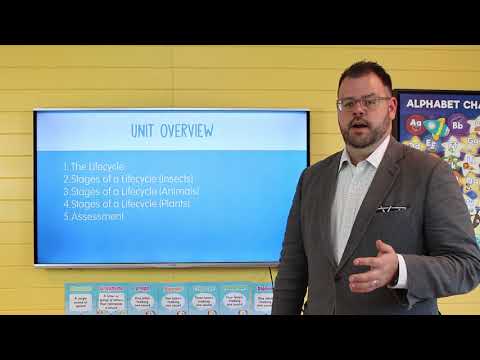
This is a 5 lesson unit designed to cover the first of two Biological Science content areas for year
4 students.
Lessons 2-4 could be taught in any order, and you may want to move lesson 4 up just because of the attached lab, which will take about 2 weeks of classroom time.
The topic of 'Insects' was put into lesson 2, because of the familiarity most students have with insect lifecycles, specifically butterflies.
You may want to incorporate a butterfly or insect hatching as an optional activity to this
unit as well, which you could do in line with lesson 2.
Living things have life cycles
Science involves making predictions and describing patterns and relationships
Science knowledge helps people to understand the effect of their actions
With guidance, identify questions in familiar contexts that can be investigated scientifically and make predictions based on prior knowledge
With guidance, plan and conduct scientific investigations to find answers to questions, considering the safe use of appropriate materials and equipment
Consider the elements of fair tests and use formal measurements and digital technologies as appropriate, to make and record observations accurately
Use a range of methods including tables and simple column graphs to represent data and to identify patterns and trends
Compare results with predictions, suggesting possible reasons for findings
Reflect on investigations, including whether a test was fair or not
Represent and communicate observations, ideas and findings using formal and informal representations
Questions, plans and conducts scientific investigations, collects and summarises data and communicates using scientific representations
Selects and uses materials, tools and equipment to develop solutions for a need or opportunity
Defines problems, describes and follows algorithms to develop solutions
Compares features and characteristics of living and non-living things
Describes how agricultural processes are used to grow plants and raise animals for food, clothing and shelter
Describes how adding or removing heat causes a change of state
Investigates the suitability of natural and processed materials for a range of purposes
Describes the characteristics and effects of common forms of energy, such as light and heat
Describes how contact and non-contact forces affect an object’s motion
Investigates regular changes caused by interactions between the Earth and the Sun, and changes to the Earth’s surface
Describes how digital systems represent and transmit data
Science knowledge helps people to understand the effects of their actions
Different living things have different life cycles and depend on each other and the environment to survive
With guidance, identify questions in familiar contexts that can be investigated scientifically and predict what might happen based on prior knowledge
Safely use appropriate materials, tools, equipment and technologies
Use formal measurements in the collection and recording of observations
Use a range of methods including tables and column graphs to represent data and to identify patterns and trends
Compare results with predictions, suggesting possible reasons for findings
Reflect on an investigation, including whether a test was fair or not
Represent and communicate observations, ideas and findings to show patterns and relationships using formal and informal scientific language
In this unit students will;
 Lesson 1
The Life Cycle
Lesson 1
The Life Cycle
In this lesson students will investigate some life cycles and seen how different living things move through the stages of their lives.
 Lesson 2
Life Cycle of Insects
Lesson 2
Life Cycle of Insects
In this lesson students will investigate the life cycle of insects.
 Lesson 3
Life Cycle of Animals
Lesson 3
Life Cycle of Animals
In this lesson students will investigate the life cycle of animals and how it compares to the insect life cycle.
 Lesson 4
Life Cycle of Plants
Lesson 4
Life Cycle of Plants
In this lesson students will investigate the life cycle of plants.
 Lesson 5
Life Cycles Assessment
Lesson 5
Life Cycles Assessment
In this lesson students will complete a quiz which will test what they have learnt through this unit.
These charts outline the life cycles of 16 different animals and plants. Included are Flowering Plant, Bean Plant, Waterlily, Human Being, C...
The WALT, WILF & TIB posters were created by request and consist of 14 pages including: WALT - We are learning to... WILF - What I'm...
Presentation introducing insect life cycles to students, including metamorphosis. Outlines how environmental factors impact the life cycles...
Presentation introducing non-insect animal life cycles to students, including metamorphosis. Outlines how environmental factors impact the l...
Presentation introducing plant life cycles to students, including metamorphosis. Outlines how environmental factors impact the life cycles o...
A quick summative assessment to check the science understanding of year 4 biological sciences unit, Life Cycles. This assessment covers a...
Students sequence a selection of life cycles and then create one of their own Introduction to life cycles, part of the year 4 unit on lif...
Students use their knowledge of insect (bee) life cycles to write a series of recounts from the Bee’s perspective. Increase student under...
A worksheet comparing different animals life cycles (size, gestation, # of offspring, age, etc.) using information obtained from the interne...
Science lab that allows students to observe the lifecycle of a plant through the germination of a seed. Teaching students the 4 stages of...