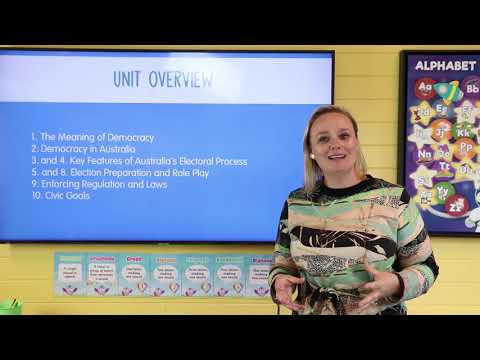
This unit is based on the Year 5 Australian Curriculum HASS Civics and Citizenships Knowledge and Understandings. Students explore Australia’s democratic government, including the meaning of terms, the three levels of government and the current representatives. They learn about the core defining values of Australia’s democratic government, the role of the Australian Electoral Commission (AEC), current issues including the citizenship saga, and compulsory voting. Students prepare and re-enact an election. Laws, regulations enforcements are explored. Students research community support groups, including those that provide support for Aboriginal and Torres Strait Islanders.
Develop appropriate questions to guide an inquiry about people, events, developments, places, systems and challenges
Locate and collect relevant information and data from primary sources and secondary sources
Organise and represent data in a range of formats including tables, graphs and large- and small-scale maps, using discipline-appropriate conventions
Examine primary sources and secondary sources to determine their origin and purpose
Examine different viewpoints on actions, events, issues and phenomena in the past and present
Interpret data and information displayed in a range of formats to identify, describe and compare distributions, patterns and trends, and to infer relationships
Evaluate evidence to draw conclusions
Use criteria to make decisions and judgements and consider advantages and disadvantages of preferring one decision over others
Reflect on learning to propose personal and/or collective action in response to an issue or challenge, and predict the probable effects
Present ideas, findings, viewpoints and conclusions in a range of texts and modes that incorporate source materials, digital and non-digital representations and discipline-specific terms and conventions
The key values that underpin Australia’s democracy
The key features of the electoral process in Australia
Why regulations and laws are enforced and the personnel involved
How people with shared beliefs and values work together to achieve a civic goal
Describes and explains the significance of people, groups, places and events to the development of Australia
Describes and explains different experiences of people living in Australia over time
Identifies change and continuity and describes the causes and effects of change on Australian society
Describes and explains the struggles for rights and freedoms in Australia, including Aboriginal and Torres Strait Islander peoples
Applies a variety of skills of historical inquiry and communication
Explains interactions and connections between people, places and environments
Acquires, processes and communicates geographical information using geographical tools for inquiry
Collect and record relevant geographical data and information from the field and secondary sources, using ethical protocols
Represent the location of places and other types of geographical data and information in different forms including diagrams, field sketches and large-scale and small-scale maps that conform to cartographic conventions of border, scale, legend, title, north point and source; using digital and spatial technologies as appropriate
Interpret maps and other geographical data and information using digital and spatial technologies as appropriate, to develop identifications, descriptions, explanations and conclusions that use geographical terminology
Identify the origin, content features and the purpose of historical sources and describe the context of these sources when explaining daily life in colonial Australia, reasons for migration and causes and effects of Federation
Discuss the values, principles and institutions that underpin Australia’s democratic forms of government and explain how this system is influenced by the Westminster system
Identify and discuss the key features of the Australian electoral process
Explain how and why laws are enforced and describe the roles and responsibilities of key personnel in law enforcement, and in the legal system
Investigate how people with shared beliefs and values work together to achieve their goals and plan for action
In this unit students explore the following concepts;
 Lesson 1
The Meaning of Democracy
Lesson 1
The Meaning of Democracy
In this lesson, students will investigate the difference between democratic and undemocratic and discuss what life in Australia would be without democracy.
 Lesson 2
Democracy in Australia
Lesson 2
Democracy in Australia
This lesson will explore who makes up Australia's democratic government and the three levels of government.
 Lesson 3
Key Features of Australia's Electoral Process
Lesson 3
Key Features of Australia's Electoral Process
In this lesson, students will explore the key features of Australia's electoral process.
 Lesson 4
Election Preparation and Role Play
Lesson 4
Election Preparation and Role Play
In this lesson, students will investigate and understand the electoral process in the Australia.
 Lesson 5
Enforcing Regulations and Law
Lesson 5
Enforcing Regulations and Law
Students will explore what life would be like without laws and regulations and who enforces these laws and regulations within their community.
 Lesson 6
Civic Goals
Lesson 6
Civic Goals
In this lesson, students we will research the community on a local level and how organisations support Aboriginal and Torres Strait Islanders.
A poster to use as a display for students to add their answers to the question – what is democracy?
Banner to use as a display for students to add their answers to the question – what is democracy?
A poster that explains the meaning of democracy specific to Australia.
This HASS presentation has been created to support the Democracy and Voting unit for Year 5. It allows the teacher to walk students through...
This resource explains the three levels of government - The Local, State and Federal Government. It also discussed the responsibilities held...
Students sort the terms into the two columns; democratic or undemocratic. This worksheet is part of a larger unit on Australian voting an...
Worksheet to record glossary of terms associated with the Year 5 Civics and Citizenships Unit, Democracy and Voting. This worksheet is pa...
Students write a brief description of each level of governments. They research and name the current leaders of local, state and federal gove...
Research and record information about their allocated core value of Australia’s democratic government. This worksheet is part of a larger...
Students record notes about each of the 5 core values of Australia’s Democratic Government. This worksheet is part of a larger unit on Au...
Students use their knowledge of the core values of democratic Australia to everyday life scenarios. This worksheet is part of a larger un...
This resource includes several tasks that prepare the students for election role play. This worksheet is part of a larger unit on Austral...
Students cut, match and paste the law/regulation to the appropriate enforcement. This worksheet is part of a larger unit on Australian vo...
Students research websites, such as the local council website, to find information on local community groups. They explore if there are ther...