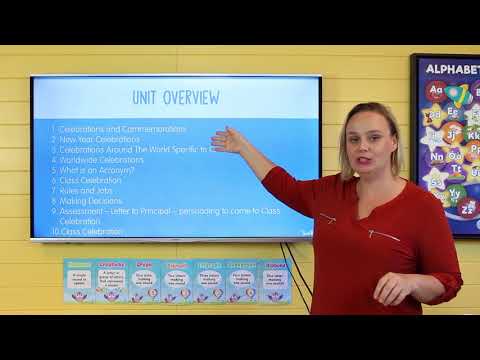
This unit is based on the Year 3 Australian Curriculum HASS Inquiry Skills, Knowledge and Understandings.
Students explore, compare and determine how and why we commemorate events, including Australian commemorations, New Year celebrations, and celebrations specific to particular countries.
They discuss acronyms and understand how they are applied to significant events in Australia. They learn the meanings of acronyms, such as NAIDOC and ANZAC.
Students plan a class celebration and explore planning processes, including voting, rules, jobs, delegating and decision making.
The students write a persuasive letter to the principal, inviting him/her to their celebration.
Pose questions to investigate people, events, places and issues
Locate and collect information and data from different sources, including observations
Record, sort and represent data and the location of places and their characteristics in different formats, including simple graphs, tables and maps, using discipline-appropriate conventions
Draw simple conclusions based on analysis of information and data
Interact with others with respect to share points of view
Present ideas, findings and conclusions in texts and modes that incorporate digital and non-digital representations and discipline-specific terms
The importance of Country/Place to Aboriginal and/or Torres Strait Islander Peoples who belong to a local area
How the community has changed and remained the same over time and the role that people of diverse backgrounds have played in the development and character of the local community
Days and weeks celebrated or commemorated in Australia (including Australia Day, Anzac Day, and National Sorry Day) and the importance of symbols and emblems
Celebrations and commemorations in places around the world (for example, Chinese New Year in countries of the Asia region, Bastille Day in France, Independence Day in the USA), including those that are observed in Australia (for example, Christmas Day, Diwali, Easter, Hanukkah, the Moon Festival and Ramadan)
Identifies celebrations and commemorations of significance in Australia and the world
Describes and explains how significant individuals, groups and events contributed to changes in the local community over time
Applies skills of historical inquiry and communication
Describes the ways people, places and environments interact
Acquires and communicates geographical information using geographical tools for inquiry
Collect and record relevant geographical data and information from the field and other sources
Represent data and the location of places and their characteristics by constructing tables and simple graphs and maps of appropriate scale that conform to cartographic conventions of border, scale, legend, title and north point
Interpret maps and other geographical data and information to develop identifications, descriptions, explanations and conclusions, using geographical terminology including simple grid references, compass direction and distance
Identify the origin and content features of primary sources when describing the significance of people, places and events
The significance of Country and Place to Aboriginal and Torres Strait Islander peoples who belong to a local area
A significant example of change and a significant example of continuity over time in the local community, region or state/territory
The role that people of diverse backgrounds have played in the development and character of the local community and/or other societies
One significant narrative, myths or celebration from the past
Significance of days and weeks celebrated or commemorated in Australia and the importance of symbols and emblems, including Australia Day, ANZAC Day, Harmony Week, National Reconciliation Week, NAIDOC week and National Sorry Day
Significance of celebrations and commemorations in other places around the world
Students will:
 Lesson 1
Celebrations And Commemorations
Lesson 1
Celebrations And Commemorations
In this lesson, students explore, compare and determine how and why we commemorate events, including Australia Day commemorations.
 Lesson 2
New Year Celebrations
Lesson 2
New Year Celebrations
In this lesson, students explore and compare the New Year celebrations that are held in Australia and China.
 Lesson 3
Celebrations Around The World
Lesson 3
Celebrations Around The World
In this lesson, students identify key information about celebrations from other countries around the world.
 Lesson 4
Worldwide Celebrations
Lesson 4
Worldwide Celebrations
In this lesson, students explore and compare how the same events are celebrated in different countries.
 Lesson 5
What Is An Acronym
Lesson 5
What Is An Acronym
In this lesson, students discuss acronyms and how they are applied to significant events in Australia and what the stand for, such as NAIDOC and ANZAC.
 Lesson 6
Class Celebration
Lesson 6
Class Celebration
In this lesson, students start to plan for a party. They explore the decision making progress.
 Lesson 7
Rules And Jobs
Lesson 7
Rules And Jobs
In this lesson, students continue to plan and prepare for the class celebration, They explore and decide upon rules and jobs.
 Lesson 8
Making Decisions
Lesson 8
Making Decisions
In this lesson, students learn to make fair decisions. They learn the voting process and come up with group decisions.
 Lesson 9
Letter To Principal
Lesson 9
Letter To Principal
In this lesson, students write a letter to the principalpersuading him/her to come to our class celebration.
 Lesson 10
Class Celebration
Lesson 10
Class Celebration
In this lesson, students host their class celebration.
The WALT, WILF, WAGOLL & TIB posters were created to support our Popart classroom theme and include: WALT - We are learning to... WI...
This Brainstorm Display was desgned to use in order to promote classroom discussions. You can write the question on the display and use post...
This poster was designed to be used a an individual or whole class graphic organiser for students to record what they already know about a u...
This resource was designed to record students wonderings about a unit of work. That is, what questions would they like answered, and what do...
The Wonder Wall display header has been developed to be used as a word wall display to introduce vocabulary associated with various units of...
This banner has been designed to feature along your classroom Word Wall.
This set of blank word wall cards allows you to add vocabulary to your word wall as the need arises. Create your own customised word wall ba...
Students will create a Celebrations and Commemorations Calendar to display in the classroom, which forms part of the Year 3 HASS History Uni...
This presentation has been created to support you throughout the Year 3 HASS History Unit - Celebrations and Commemorations. Simply work...
This set of posters features information about popular celebrations around the world. It supports the Year 3 HASS History Unit Plan - Ce...
This poster explains the meaning of ANZAC Day as a day of commemoration in Australia. It has been developed to support the Year 3 HASS H...
This poster explains the meaning of NAIDOC week as a week of celebration in Australia. It has been developed to support the Year 3 HASS...
This worksheet was designed to be used a an individual graphic organiser for students to record what they already know about a unit, what th...
This Australia Day worksheet requires students to show the various ways they celebrate Australia Day and write the date of this annual event...
Students will read a comprehension and complete activities asking them to compare Chinese New Year celebrations to Western New Year Celebrat...
In this worksheet, we look at various celebrations from around the world, identifying the date, what the event is and why it is celebrated....
Students will compare the way that Easter is celebrated in Australia to the way that Easter is celebrated in another country. This worksh...
This worksheet has been designed as a graphic organiser to help students organise ideas to reach a decision. It forms part of the Year 3...
Writing a strong persuasive letter is an important component of the Year 3 curriculum. This sample persuasive letter has been developed...
Students will write a persuasive letter to their principal, which forms part of the assessment for the Year 3 HASS History Unit of Work - C...