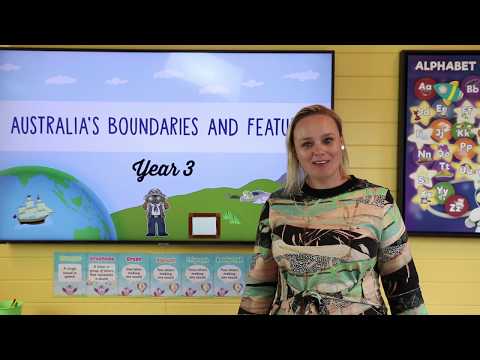
This unit is based on the Year 3 Australian Curriculum HASS Inquiry Skills, Knowledge and Understandings. Students explore the boundaries of Australia both pre and post-European settlement. They compare the two and discuss the implication of settlement on indigenous boundaries. They investigate how oral communication is used to convey indigenous stories about the creation of natural landmarks, as well as how songs were used as a type of map. Students learn some of the natural and manmade features of Australia and use digital technologies to locate these on a map of Australia. They research and create an information report on a natural feature of Australia.
Pose questions to investigate people, events, places and issues
Locate and collect information and data from different sources, including observations
Sequence information about people’s lives and events
Examine information to identify different points of view and distinguish facts from opinions
Interpret data and information displayed in different formats, to identify and describe distributions and simple patterns
Draw simple conclusions based on analysis of information and data
Interact with others with respect to share points of view
Present ideas, findings and conclusions in texts and modes that incorporate digital and non-digital representations and discipline-specific terms
The representation of Australia as states and territories and as Countries/Places of Aboriginal and Torres Strait Islander Peoples; and major places in Australia, both natural and human
The similarities and differences between places in terms of their type of settlement, demographic characteristics and the lives of the people who live there, and people’s perceptions of these places
Applies skills of historical inquiry and communication
Examines features and characteristics of places and environments
Examines differing perceptions about the management of places and environments
Acquires and communicates geographical information using geographical tools for inquiry
Collect and record relevant geographical data and information from the field and other sources
Interpret maps and other geographical data and information to develop identifications, descriptions, explanations and conclusions, using geographical terminology including simple grid references, compass direction and distance
Representation of Australia as states and territories, and Australia’s major natural and human characteristics
Similarities and differences between places in terms of their type of settlement, demographic characteristics and the lives of the people who live there
Identify the origin and content features of primary sources when describing the significance of people, places and events
In this unit students will explore the following concepts;
 Lesson 1
Australia's Boundaries
Lesson 1
Australia's Boundaries
In this lesson, students will look at Australia's states and territories, including major cities and regional centres.
 Lesson 2
Pre-Colonisation Boundaries
Lesson 2
Pre-Colonisation Boundaries
In this lesson, students will explore the boundaries of Australia both pre and post colonisation.
 Lesson 3
Aboriginal Dreaming
Lesson 3
Aboriginal Dreaming
In this lesson, students will explore the Indigenous Australian clans around Australia and learn how they communicated through message sticks, dreamtime stories and songs for maps.
 Lesson 4
Dreamtime Stories
Lesson 4
Dreamtime Stories
This lesson will explore how indigenous Australians communicated through Dreamtime stories, and how the natural features of Australia impacted these stories.
 Lesson 5
Major Natural Features of Australia
Lesson 5
Major Natural Features of Australia
Students will identify and describe the major features of Australia.
 Lesson 6
Information Report - Australia's Boundaries and Features
Lesson 6
Information Report - Australia's Boundaries and Features
Students will research and create an information report on one of Australia's features.
This poster was designed to be used a an individual or whole class graphic organiser for students to record what they already know about a u...
This resource was designed to record students wonderings about a unit of work. That is, what questions would they like answered, and what do...
The Wonder Wall display header has been developed to be used as a word wall display to introduce vocabulary associated with various units of...
Explore the rich cultural heritage of Indigenous communities with this informative and visually stunning map resource. It highlights the div...
Students will sort various features of landscapes to determine whether they are natural, managed or constructed features. This forms part...
This worksheet was designed to be used a an individual graphic organiser for students to record what they already know about a unit, what th...
Students are asked to cut out each of the pictures of famous Australian landmarks and paste them into the spaces to show the State in which...
Australia's Features - Self-Assessment Rubric
Australia’s Features Information Report Plan